
   INTRODUCTION

      SUSAN IOANNOU

        Why Does Anyone Write?

   CONTENTS

      THE POEMS OF SUSAN IOANNOU

         CHAUCER CLASS: A TALE OF MIDDLE AGE
         MOTHERING DAYS
         IF I WERE A PEBBLE
         BUNDLE UP
         FIRST SNOW
         NIGHT HIGHWAY, FREEZING RAIN
         CARDIAC HUNTED
         THE ANGEL OF DEATH VISITS GRETA EBEL
         INHERITANCES
         MY PRUSSIAN PAST HOLDS NO COMFORT
         LAST PHOTOGRAPHS
         APPOINTMENT ABOVE FLORENCE: VISITING SIR HAROLD ACTON
         A CIVILIZED LIFE
         BALKAN WINTER
         CAN WE IMAGINE . . .
         NORTH OF CAPRICORN
         WHO WOULD BE A GOD
         SCULPTOR
         A MODERN POET AND HIS MUSE
         ILLUSION
         GEM LURE
         UNDERGROUND
         PETROLOGIST

   POST SCRIPTUM

      SUSAN IOANNOU

         Biographical Note

Why does anyone write? In my case, it began simply as fun, around the age
of seven, as soon as I could pencil words phonetically into short sentences.
Delighting in radio adventures of the day, first I scrawled detective
stories crackling with sound effects. Gradually, their noise gave way to
tamer fictions about kittens and horses. Following the Beat Generation,
like many adolescents I turned inward through poetry.

As a woman, I shaped my early books close to home, in the domesticity of
Motherpoems (1985), the neighbourhood of Familiar Faces/Private
Griefs (1986), and the childlike playfulness of Read-Aloud Poems
(1993, Revised 2001) and occasional light verse. Over the years, gradually
poetry became a quest. As my focus shifted to the angst of middle age,
Clarity Between Clouds (1991) looked for patterns to make sense of
the life lived. In turn, while staring uneasily ahead at ageing, illness,
and death, Where the Light Waits (1996) raised the broader
question of what makes us civilized. In my latest (yet to be published)
manuscript Petra, the angle has widened further, filtering the
science of Earth’s metals, gemstones, and mining through folklore and
imagination. What marvels and quirks there are in our shared physics.
Under shifting surfaces, I continue to look for a mysterious order that
interconnects us and inspires our sense of wonder and aesthetic beauty.
I am also a realist, however, whose darker poems on individual suffering
and war probe the violations of that order.

In my poetics, the writer is a magician. She creates a parallel world
sensuous enough to draw the reader in and become, for a few moments,
part of the illusion. The poem is vicarious experience (be that experience
actual or made up, lyric or narrative). "It’s just like a movie inside my
head," a child once paid my writing a high compliment. Ideally, I want the
language to say what it must without wasting breath, to be as three-
dimensional as a rock on my palm, and even if the subject matter is brutal,
still to feel part of a larger, pleasing pattern. Little by little, I am
also learning how to make my lines more musical -- a challenge for my next
book.

Travel, crisis, and danger sharply contour a poet’s writing. My dramas,
however, have been essentially internal. Any poems set abroad are purely
imaginary, inspired by reading the newspaper, or absorbing the accounts of
better-travelled friends. While I enjoy socializing occasionally, within
a quiet, family-centred life I also need long stretches alone, often
retreating to the anonymity of coffee shops and subway trains to write.
What follows is a cross section of my work, arranged from earlier to
recent, suggesting the range of my subjects and treatments. I hope the
poems stand up to your scrutiny. Even more, I hope you enjoy them.
Ice -— and you spin out so fast
  it’s slow, slow, sliding and looping
    across a white silence
      numbing your mind.

Not even your eyes move.
  Your whole body is touch -—
    waiting and waiting
      for tires squealing, a smash, the thud.

Waiting, as farther and farther you spin
  out past the flash in the centre lane.
    The snow is an endlessly winding sheet
      blackness tightens around you.

When will it swerve, that last
  look in mortality’s face?
    When will physics play out
      steel meeting steel beyond grace?

Waiting, as even farther you spin
  into the hurtling curb lane.
    Your heart has frozen its beating.
      Breath is an icicle jammed in your throat.

Why did you ever set out?
  Why did you listen to them?
    Why did you dare
      to challenge the wind?

And after the impact
  will you be able to feel another?
    Will you be able
      to feel?

Goodnight to this dizzying world.
  Goodnight to uncounted seconds.
    Goodnight to far off, lost friends,
      to whatever this metal womb entombs.

Goodnight
   —- and you feel the slide
     back, back
        skimming the snow-mounded rail,

back, back,
  sliding from sideswiping beams,
    back, back,
      wet gravel crunching

slower and slower -— till pulse
  flickers into your brain
     —- you just might
         make it through this.

Slower and slower -— a lurch.
  Your pores feel the side panel buckling,
    window rim fracturing glass.
      One last rattle, low scrape.

Headlights melt. From the dark
  your eyes
    your fear
      your life

ricochet back into place.
". . . Now you’ve become brooches and pictures and rings,
And I have an ashtray that’s made from your wings . . ."
". . . Never to dig out her bones againMy recitation is at an end.
Nor touch them in their earthly bed
For one must leave the dead to rest."
The wealthy Umbrian farmerAn acre of earth
raising his glass at the marble-topped table
sweeps the air with wide hands:
"All my young days
around the whole world I have travel.
Here is the best. I stay."
Twenty years motoring weekly to King’s College, Cambridge,Remember the luminescence of Turner country,
painting seventeen hundred precise watercolours’
intricate revelations of cornice and spire
to the fat American guest at her Tate retrospective
"I grow roses," Lady Brockington sums up her life.
what train whistles into the evening,
when is the channel crossing,
before the shutter’s last click?
APPOINTMENT ABOVE FLORENCE:
VISITING SIR HAROLD ACTON

(for Merla McMurray, March 1990)

I

We create our own estates
within the mind.

Yours a quiet dusk in Italian hills
   amber on stucco and sandstone,
     six centuries’ adoration of hands:

   Villa La Pietra -— first milestone
    crowning a cypress drive up vineyards and olive

   Villa La Pietra —- first step stone
    to pleasure flowering year round

In your calm, vanished ages blend:
the facade where Renaissance lintels
   curled to Baroque circa 1620
     for Luigi Capponi, the Cardinal,
opens into a frescoed rotunda
   circling up wrought, pewter stairs.
Glassed over since the 17th century,
   below, da Maiano’s fountain still splashes,
     ghost of a quattrocento well.

II

We create our own estates
within the mind.

Objets d’art -— just so -— on the chinoiserie table,
   from a red velvet wing chair
     the butler is silently summoned
for Scotch —- in the right glasses -—
   and canapés.

From sixty rooms, evening opens
   French doors to parterre and sculpture
     —- giardino grande, restored in 1904.
Steps curve under pines, by fish pond and hedges
   till, along pea gravel, down a mossed second stair,
     beyond the round lower terrace, day rests.
Within his wisteria pergola, fading
   Apollo turns from Florence, departed friends,
     and gazes at shield and mitre cresting the house.

By its side, 400 years, the ilex bends
   toward rose-hung columns and rocaille grotto
     where, like sky-ceilinged rooms,
       boxed lawns edge twilight down the slope
round Hercules’ shadowy peristyle,
   and Marinali’s granite colossus
     lit by fireflies.

III

We create our own estates
within the mind.

Yours, time marked off with boxwood and yew
   hedge upon hedge mounting the theatre’s grass.
Music, whispering, laughter:
   six leafy wings shelter each a commedia player,
     Francesco Bonazza’s 18th-century marbles
       your father rescued from the Palladian villas
         abandoned along the Brenta Canal.

Yours, time outgrown in old kitchen gardens,
   giardino segreta, where a glass limonaia
     ripens azalea and orange,
while the crumbling pomario wall
   —- so startling its robin’s-egg blue -—
     turns memory back to the house,
past servants, white in the sunken pantry,
   past potted oxlip, gardenia
     blooming pink along halls,
and climbs another dark stair,
   nodding as heavy portraits rise
     toward you along the wall.

When you sit in a corner by the drawing-room window
   and chat about semiprecious stones,
     you know this is where the light waits,
its legacy a debt one repays
   by showing admirers the house and grounds,
     by sipping Scotch -— in the right glass -—
       and offering a salver of canapés.

With courteous smiles you point out
   your father’s petit point chair,
     and chuckle when a guest mentions
       —- Berenson? Oh my yes, and Duveen —-

while it is such a bother these days,
   spring sniffles, the servants . . .
     and you just turned 85.

Welcome to Newsgroup alt.centipede. Established
       just for writers, poets, artists, and anyone who is creative. A
       place for anyone to participate in, to share their poems, and
       learn from all.  A place to share *your* dreams, and philosophies.
       Even a chance to be published in a magazine.

       The original Centipede Network was created on May 16, 1993.
       Created because there were no other networks dedicated to such
       an audience, and with the help of Klaus Gerken, Centipede soon
       started to grow, and become active on many world-wide Bulletin
       Board Systems.

       We consider Centipede to be a Public Network; however, its a
       specialized network, dealing with any type of creative thinking.
       Therefore, that makes us something quite exotic, since most nets
       are very general and have various topics, not of interest to a
       writer--which is where Centipede steps in! No more fuss. A writer
       can now access, without phasing out any more conferences, since
       the whole net pertains to the writer's interests. This means
       that Centipede has all the active topics that any creative
       user seeks. And if we don't, then one shall be created.

       Feel free to drop by and take a look at newsgroup alt.centipede
  Ygdrasil is committed to making literature available, and uses the
  Internet as the main distribution channel. On the Net you can find all
  of Ygdrasil including the magazines and collections. You can find
  Ygdrasil on the Internet at:

    * WEB: http://www.synapse.net/~kgerken/

    * FTP: ftp://ftp.synapse.net/~kgerken/

    * USENET: releases announced in rec.arts.poems, alt.zines and
              alt.centipede

    * EMAIL: send email to kgerken@synapse.net and tell us what version
         and method you'd like. We have two versions, an uncompressed
         7-bit universal ASCII and an 8-bit MS-DOS lineart-enchanced
         version.  These can be sent plaintext, uuencoded, or as a
         MIME-attachment.

  . REMEMBERY: EPYLLION IN ANAMNESIS (1996), poems by Michael R. Collings

  . DYNASTY (1968), Poems by Klaus J. Gerken
  . THE WIZARD EXPLODED SONGBOOK (1969), songs by KJ Gerken
  . STREETS (1971), Poems by Klaus J. Gerken
  . BLOODLETTING (1972) poems by Klaus J. Gerken
  . ACTS (1972) a novel by Klaus J. Gerken
  . RITES (1974), a novel by Klaus J. Gerken
  . FULL BLACK Q (1975), a poem by KJ Gerken
  . ONE NEW FLASH OF LIGHT (1976), a play by KJ Gerken
  . THE BLACKED-OUT MIRROR (1979), a poem by Klaus J. Gerken
  . JOURNEY (1981), a poem by Klaus J. Gerken
  . LADIES (1983), a poem by Klaus J. Gerken
  . FRAGMENTS OF A BRIEF ENCOUNTER (1984), poems by KJ Gerken
  . THE BREAKING OF DESIRE (1986), poems by KJ Gerken
  . FURTHER SONGS (1986), songs by KJ Gerken
  . POEMS OF DESTRUCTION (1988), poems by KJ Gerken
  . THE AFFLICTED (1991), a poem by KJ Gerken
  . DIAMOND DOGS (1992), poems by KJ Gerken
  . KILLING FIELD (1992), a poem by KJ Gerken
  . BARDO (1994-1995), a poem by Klaus J. Gerken
  . FURTHER EVIDENCES (1995-1996) Poems by Klaus J. Gerken
  . CALIBAN'S ESCAPE AND OTHER POEMS (1996), by Klaus J. Gerken
  . CALIBAN'S DREAM (1996-1997), a poem by Klaus J. Gerken
  . THE LAST OLD MAN (1997), a novel by Klaus J. Gerken
  . WILL I EVER REMEMBER YOU? (1997), poems by Klaus J. Gerken
  . SONGS FOR THE LEGION (1998), song-poems by Klaus J. Gerken
  . REALITY OR DREAM? (1998), poems by Klaus J. Gerken
  . APRIL VIOLATIONS (1998), poems by Klaus J. Gerken
  . THE VOICE OF HUNGER (1998), a poem by Klaus J. Gerken

  . SHACKLED TO THE STONE, by Albrecht Haushofer - translated by JR Wesdorp

  . MZ-DMZ (1988), ramblings by Igal Koshevoy
  . DARK SIDE (1991), ramblings by Igal Koshevoy
  . STEEL REIGNS & STILL RAINS (1993), ramblings by Igal Koshevoy
  . BLATANT VANITY (1993), ramblings by Igal Koshevoy
  . ALIENATION OF AFFECTION (1993), ramblings by Igal Koshevoy
  . LIVING LIFE AT FACE VALUE (1993), ramblings by Igal Koshevoy
  . HATRED BLURRED (1993), ramblings by Igal Koshevoy
  . CHOKING ON THE ASHES OF A RUNAWAY (1993), ramblings by I. Koshevoy
  . BORROWED FEELINGS BUYING TIME (1993), ramblings by Igal Koshevoy
  . HARD ACT TO SWALLOW (1994), ramblings by Igal Koshevoy
  . HALL OF MIRRORS (1994), ramblings by Igal Koshevoy
  . ARTIFICIAL BUOYANCY (1994), ramblings by Igal Koshevoy

  . THE POETRY OF PEDRO SENA, poems by Pedro Sena
  . THE FILM REVIEWS, by Pedro Sena
  . THE SHORT STORIES, by Pedro Sena
  . INCANTATIONS, by Pedro Sena

  . POEMS (1970), poems by Franz Zorn

  All books are on disk and cost $10.00 each. Checks should be made out to
  the respective authors and orders will be forwarded by Ygdrasil Press.

  YGDRASIL MAGAZINE may also be ordered from the same address: $5.00 an
  issue to cover disk and mailing costs, also specify computer type (IBM
  or Mac), as well as disk size and density. Allow 2 weeks for delivery.

  Note that YGDRASIL MAGAZINE is free when downloaded from Ygdrasil's
  World-Wide Web site at http://www.synapse.net/~kgerken.
  All poems copyrighted by their respective authors. Any reproduction of
  these poems, without the express written permission of the authors, is
  prohibited.

  YGDRASIL: A Journal of the Poetic Arts - Copyright (c) 1993 - 2001 by
  Klaus J. Gerken.

  The official version of this magazine is available on Ygdrasil's
  World-Wide Web site http://www.synapse.net/~kgerken.  No other
  version shall be deemed "authorized" unless downloaded from here.
  Distribution is allowed and encouraged as long as the issue is nchanged.
  All checks should be made out to: YGDRASIL PRESS


  COMMENTS

    * Klaus Gerken, Chief Editor - for general messages and ASCII text
    submissions. Use Klaus' address for commentary on Ygdrasil and its
    contents: kgerken@synapse.net

    * Pedro Sena, Production Editor - for submissions of anything
    that's not plain ASCII text (ie. archives, GIFs, wordprocessored
    files, etc) in any standard DOS, Mac or Unix format, commentary on
    Ygdrasil's format, distribution, usability and access:
    art@accces.com

    We'd love to hear from you!

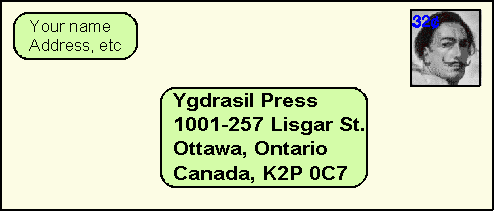
    Or mailed with a self addressed stamped envelope, to: